


 News Desk
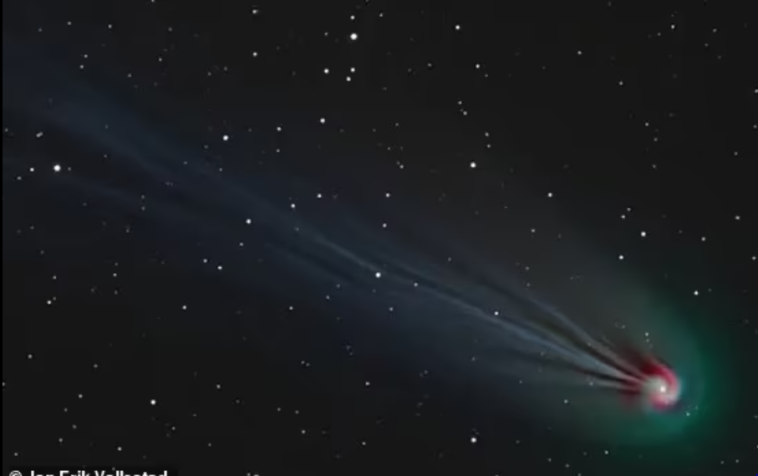
Stunning new images have been released of a ‘devil comet‘ that is the size of Manhattan.
The new pictures show the giant ice ball has been hiding a spiraling swirl of red, green and blue gas around its icy core.
The spirals, which look like a yin-yang symbol, are caused by the comet ejecting streams of cryomagma while it spins and because it makes a full rotation within two weeks, the jets of ice are twisted into the swirls seen in the images.

Stargazers are see the comet with the naked eye by the end of March and during April 8’s solar eclipse – across the 115-mile strip from Maine down to Texas – if they’re in regions away from city lights and have a clear view of the night sky.
Astrophotographer Jan Erik Vallestad captured the close-up images using specialized software to zoom in on the comet’s coma – a scientific term for a cloud of icy dust.
The comet, known as the ‘devil comet,’ got its name last year when a photo captured it with a horseshoe shape at its crest, which resembled horns.
But Vallestad’s recent images, taken from Norway, provide a much more detailed picture of Pons-Brooks as it travels closer to the sun.
He explained that most astronomers are focusing on the comet’s tail, which grows longer with each passing night, but Vallestad decided to hone in on the comet’s core.
‘I focused solely on the core here, disregarding almost everything else,’ said Vallestad, adding that many astronomers believe the comet’s outbursts are a sign of cryovolcanic activity, ‘so this might be further evidence toward just that.’
The comet, named 12P/Pons-Brooks, is 10.5 miles wide and experiences periodic volcanic-like ‘flare-ups’ that make it shine 100 times brighter than usual as it gets closer to the sun.
Pons-Brooks can only be seen with a telescope, binoculars or through a long-exposure photograph toward the Pisces constellation in the early evening.
Cryovolcanic activity occurs when a comet experiences volcano-like eruptions of ice and gas.
The comet’s solar radiation causes fissures in its nucleus – which is made up of rock, dust and frozen gas – to crack open and spray water, ammonia and methane, called cryomagma, from its core into space.



GIPHY App Key not set. Please check settings