


 News Desk
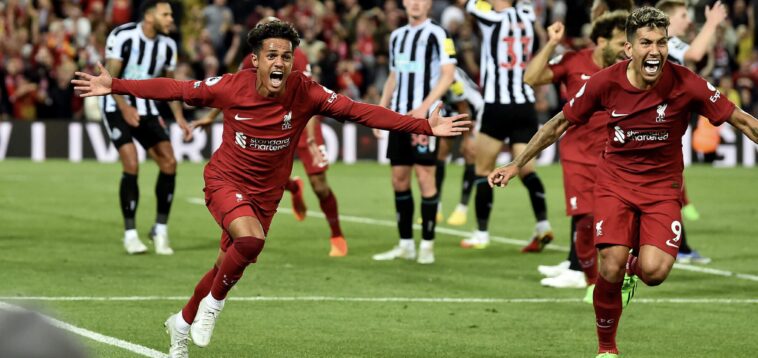
“What a talent he is, eh?” Klopp said, delighted that Liverpool, after a lengthy pursuit, had finally got their young man.
“It’s a step up, but one we know he is more than capable of making, which is why we were so keen for so long to sign him,” the Liverpool manager said. “He has the perfect environment here to learn and develop. With us, a player of Fabio’s profile will get opportunity — along with space — to improve, learn and develop further.”
That was July 2022, when a 19-year-old Fabio Carvalho completed his move to Anfield after a season illuminating the Championship with title winners Fulham, excelling in a variety of creative, attacking roles. “He has a brilliant career in front of him,” Fulham head coach Marco Silva said a little ruefully, sad to see him go.

Carvalho is still young enough and talented enough to have a brilliant career in front of him, but 18 months later, at the age of 21, he is back in the Championship, having joined Hull City on loan for the rest of the season. He made his debut for them last night, embarking on 14 dribbles against Norwich City — the second highest total by any player in a Championship game this season — but still ended up on the losing side.
In some ways, the Carvalho case is complex, as The Athletic explored in this article towards the end of his brief, unhappy loan spell at RB Leipzig of Germany’s top flight:
But it is also a familiar story of a young player thriving at a lower level, joining a bigger club, struggling with that step up, becoming frustrated and finding himself dropping down the divisions again in the hope of kick-starting a career that has stalled.
It has been a feature of this winter transfer window so far:
There’s Carvalho being loaned to Hull, having played just 512 minutes of league football (347 for Liverpool last season, 165 at Leipzig in this one) over the previous 18 months.
Former England Under-21 full-back Djed Spence, now 23, has moved to Genoa of Italy on loan with a view to a permanent move, after just seven minutes of Premier League football (and having not nailed down a regular starting place during loans to France’s Rennes and Championship side Leeds United) since joining Tottenham Hotspur from Middlesbrough in a projected £20million deal in the same window Carvalho left Fulham.
And Ashley Phillips, 18, dropped back down to the Championship to join Plymouth Argyle on loan, having not had a sniff of first-team football in five months at Spurs since his arrival from the second tier’s Blackburn Rovers.
Others, such as Andrey Santos, 19, of Chelsea and Manchester United’s 22-year-old Facundo Pellistri might be looking for loan moves this month, having been lured from Brazil’s Vasco da Gama and Penarol of Uruguay respectively by the appealing notion of a fast track to stardom, only for their development to stall (with Santos barely getting a look-in even on loan to Nottingham Forest in the first half of this season).
Every career is different; there are no hard-and-fast rules where development is concerned. Some young players thrive after joining a bigger club, as Jude Bellingham has since leaving Birmingham City for Borussia Dortmund at age 17 and then moving on to Real Madrid at 19. Like Pedri, since leaving second-tier Las Palmas for Barcelona at 17 and like Alphonso Davies, who left MLSside Vancouver Whitecaps for Bayern Munich at 18.
But far too many struggle with the step up in status, whether on the pitch, off the pitch or both. A career that has been in the ascendancy — hence the transfer to an elite club — becomes complicated by other factors: a change in surroundings, a change in profile and a head-spinning change in wealth coming at a time when, in many cases, playing time (essential to their continued development) is vastly reduced.
There is no guarantee Carvalho’s transition to the Premier League would have been seamless had he stayed at newly-promoted Fulham, but equally it is hard to imagine a scenario where he would have found himself dropping down to the Championship again in January 2024 in the hope of playing regularly.
This choice of Hull was carefully considered. Carvalho had other options, including clubs in the Premier League, but having barely featured at Liverpool after the opening months of last season and having endured a difficult spell at Leipzig, he was enthused by head coach Liam Rosenior’s suggestion that he could potentially start the remaining 20 regular-season league games and find his confidence and rhythm again as one of the main players in what is a promotion-chasing team — and from there, ideally, to return to Liverpool in the summer to compete for a place in Klopp’s side.
But that is the level he and Klopp expected him to be at when he arrived at Anfield. Instead, the steep upward trajectory of that breakthrough year at Fulham has been followed by a slump: a reduction in playing time and a struggle, at both Liverpool and Leipzig, to seize the most of the chances when they arose.
Nobody questions his talent, least of all Klopp, but loss of youthful momentum can severely disrupt a career, which is why young players need to think long and hard before leaving a promising situation at one club for the uncertainty that awaits them higher up football’s food chain.



GIPHY App Key not set. Please check settings