


 News Desk
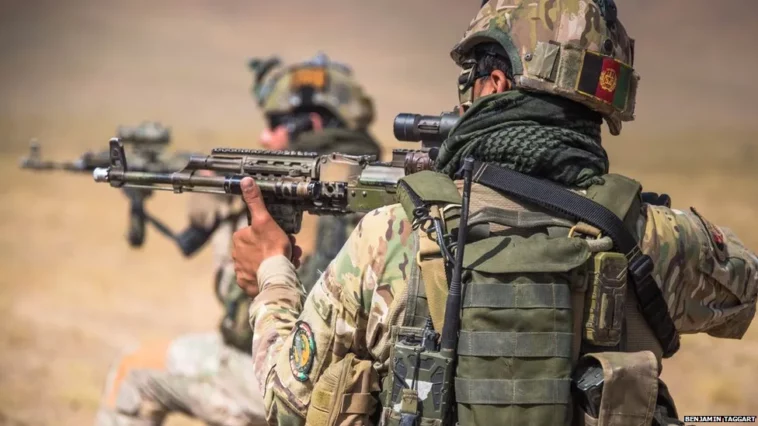
Some British Army members who say they tried to vouch for Afghan special forces, who are now in danger of being sent back to the Taliban, were never contacted by the Ministry of Defence.
Multiple sources have told the BBC that some people who offered to give Afghan soldiers references never heard back.
Many of the soldiers were subsequently denied help by a scheme designed to settle those in danger in the UK.

The Cabinet Office says it is “working across government to meet our commitment to resettle eligible Afghans in the UK”.
The issue has resulted in tensions between two senior ministers.
About 200 members of Afghan special forces, trained and funded by the UK, currently living in Pakistan face imminent deportation to Afghanistan, BBC Newsnight reported this week.
The men were told they did not fall under the UK’s Afghan Relocation and Assistance Policy (ARAP), which was designed to help those who served alongside the UK military.
But members of the armed forces who served with them have called their treatment a betrayal.
Over the course of nearly two decades, the British trained, funded and worked with two units of Afghan special forces, CF-333 and ATF-444, collectively known as the Triples.
They were elite troops who went on the most challenging missions, often alongside British special forces.
When the Taliban returned to Afghanistan in 2021, the Triples were considered to be top of their list for retribution. Some managed to escape in the chaotic evacuation of Kabul, but many did not.
Those who were left behind either in Afghanistan or neighbouring countries were told to seek help from the UK’s ARAP scheme.
The policy states it was set up to help “Afghan citizens who worked for or with the UK government in Afghanistan in exposed or meaningful roles”, a criteria any of those who fought alongside the Triples were certain they met.
Many Triples were given references by their British colleagues. One of them was Alex, a former British soldier, who said: “I provided details about the individual that I served with on the ground in Afghanistan to the ARAP team and never got a response.
“I am aware of a number of other people who served alongside the Triples and never received any contact from the MoD or ARAP.
“The cases were all rejected in the first place and were then rejected on appeal.”
BBC Newsnight has heard evidence from multiple sources that people who offered to provide those references were never contacted by the ARAP team, before the case was rejected.
Supporters of the Triples have said it led to a large number of former special forces being left in limbo in Afghanistan and neighbouring countries.
“We talk a lot about veterans and their mental health,” said Alex.
“To think that you’ve left these people behind, you hear what they’re going through. They were looking after you on the ground and you can’t help them.”
Previously it has said: “Each ARAP application is assessed individually and in accordance with published policy, and we do not automatically make a decision on eligibility based on a job role.”
Following the BBC’s report, armed forces minister James Heappey defended the government’s record in the Commons on Monday.
He said that identification was a huge issue, telling MPs: “There is also the reality of how hard it is to verify the service of those who just served in the unit rather than explicitly alongside UK personnel.”
Alex said: “It makes me so angry, particularly to hear the minister say that it’s hard to verify these people, when they’ve clearly made no attempt to verify them, not even reaching out to their own people.”
The armed forces minister also told the Commons: “CF333 and ATF444, known as the Triples, were Afghan-led taskforces set up to counter drug trafficking and organised crime and they reported into the Afghan Ministry of Interior Affairs. They are therefore a component of the Afghan national security forces and are not automatically in scope for relocation under ARAP.”
But on Wednesday, his government colleague Johnny Mercer, the minister for veterans, appeared to contradict him.
Mr Mercer said: “I am clear that we have a duty to these individuals. While technically the minister for armed forces was right that they were led and had direct command chains into the Afghan government, there will be no attempt whatsoever from this government to close down avenues for those who served in 333 and 444.”
Security Minister Tom Tugendhat weighed in behind Mr Mercer, posting on X: “Many of us served alongside TF333/444. They were integral to our combat strength. Good to hear @JohnnyMercerUK’s words.”
The pair are among a number of MPs who served alongside the Triples, resulting in clear tensions within government.



GIPHY App Key not set. Please check settings